What Is AI Search And Why Does It Matter?
The Shift From Old SEO To New AI Search
There have been more changes in the world of searches within the last couple of years than ever seen before during the previous decade. By now, those who still dream of getting to number one on Google miss the point – the actual question is whether your content can be used by artificial intelligence to answer queries. This is what defines its ranking within AI search engine results.
Google AI Overviews, ChatGPT, and Perplexity work differently from traditional search engines. These platforms do not provide you with ten blue links but rather come up with a summary of an answer taken from various sources. Consequently, you will not only compete with other websites in the ranking system but also strive to become a source used by artificial intelligence in its generated responses.
The whole process became known as Generative Engine Optimization and includes making sure that your content marketing Strategy is AI readable, relevant, and well-structured to be mentioned in the answer. According to recent findings, ranking positions matter no more than trust in the information.
Statistics Say a Lot About AI Overviews and Zero-Click Searches
Statistics tell us a lot. At the moment, AI Overviews appear in around 13% of search queries. It’s a very impressive figure compared to previous years.
What’s more, if AI Overviews appear in Google searches, the click-through rate of organic results drops by more than 34%. Therefore, even though you may be ranking #1 on SERPs, no one will ever click on your link.
Why not? Because the AI will give them an answer right away without requiring extra information elsewhere.
The name of this process is zero-click searching. You get everything you need, and your traffic is not redirected anywhere else.
As far as marketers and content creators are concerned, zero-click searches pose certain problems. However, in the recipe for success, there’s a magic ingredient – AI Overviews generate views in millions without requiring a single click.
How AI Search Engines Work
AI Crawl, Retrieval & Generate
AI search engines are not crawlers alone but consist of three main actions:
- Crawling – collecting information on websites
- Retrieving – choosing sources according to their relevancy
- Generating – generating information andcoming up withan answer
If a search engine collects data from multiple sources and generates a single response, then it’s called Search-Augmented Generation.
Unlike classic search engines which are mostly dependent on keyword matching, modern AI is aware of the meaning and topic relevance. Consequently, random keywords won’t help you get better results.
How to Create AI Friendly Content?
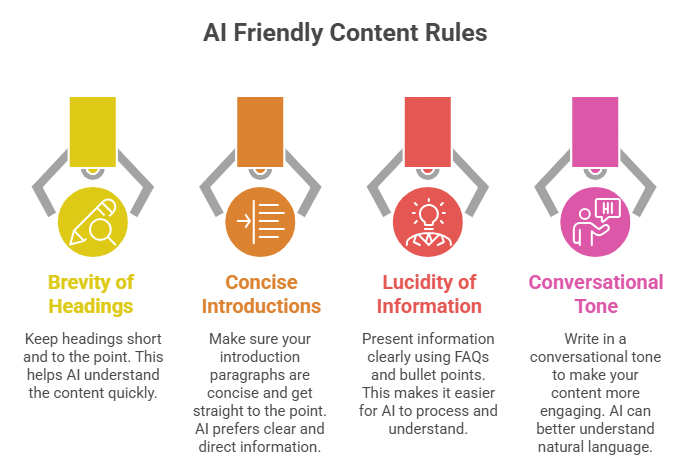
AI friendly content is much more than providing information. Thus, your content needs to follow specific rules. Think about your website as a library. The more understandable it is for AI, the greater are chances to get cited.
So, what are they?
- Brevity of headings (H2, H3, H4)
- Conciseness of answers in introduction paragraphs
- Lucidity of information (FAQ, bullet points)
- Conversational tone of writing
Information like that will definitely be used for citations since AI will not waste time on understanding your page.
Top-ranking AI Search Factors for Content Marketing
Clarity and Organization of Content
Regarding content itself, it must be clear, brief, and concise since the AI algorithm is too lazy to process anything else.
A great start point for the majority of content is the short (about 40-60 words) introduction, after which come explanations in details.
One can say that the format resembles answering questions on exams: first comes the answer.
Content Authoritative Signals (E-E-A-T)
In addition to content, AI search algorithms consider authority signals very carefully.
When dealing with expertise and authority, it is appropriate to mention some aspects like:
- Expertise
- Experience
- Authority
- Trustworthiness
These criteria together are called E-E-A-T by AI content marketers.
Hence, the chances of your site being chosen for content promotion by AI system depend greatly on whether it possesses the necessary reputation.
This means that one should build authority and credibility via mentions on other platforms.
Basics of Technical SEO
Even in the epoch of artificial intelligence, technical SEO is vital. The web resource needs to load fast, look responsive and have a logical structure.
To put it simply, AI works with high-quality content only.
AI Search Ranking Tips #1
Answer Search Queries in a Straightforward Manner
The simplest way of succeeding with the help of AI technology is to provide a direct response.
It likes the straightforwardness of the content, which doesn’t have anything unnecessary at the beginning.
Example:
Wrong: “In today’s digital world…”
Right: “To be successful in AI search ranking, you need to create well-written, well-structured and credible content.”
Yes, it seems quite obvious, but that’s what really works!
Consider User Intention
The intention of users is becoming more and more important from the SEO standpoint as AI usually solves some problems by keyword intent.
Important things to consider:
- What the users need
- What issues they have
and how you can help solving those issues.
The content written for specific intentions is always interesting to readers.
Use Structured Data and Schema Markup
Using schema and structure data will certainly improve your AI ranking, as it makes the site easier to understand and use for the readers.
Thus, there will be higher chances of getting noticed.
Create a Topic Authority
Writing one article will not work in favor of AI technology. In other words, it likes sites that have a lot of information on one subject.
Therefore, it’s better to build content clusters around one particular topic.
How to Optimize Content for AI-Based Answers?
Snippet-Oriented Content Writing
AI is all about creating content that is easier to cite. And this includes:
- Brief paragraphs
- Concise definitions
- Lists that structure information
Imagine that every segment is a standalone answer on its own.
Include FAQs and Natural Queries
People no longer type their queries like before. Instead, they ask: “How do I get better at AI SEO?”
By adding a section of frequently asked questions, you will ensure that such natural questions will be answered and indexed by AI systems.
Opt for Natural Language and Entities
While AI can understand semantic relations, not just keywords, this means that entity-based SEO becomes an essential factor.
This way, you will be able to incorporate related phrases instead of repeatedly using keywords.
Comparison between AI SEO and Traditional SEO
Feature Traditional SEO AI SEO
Purpose Keywords Answer
Objective Ranking pages In AI answers’ references
Content Style Keyword-rich Conversational and structured
Measure of Success Clicks Citations and visibility
What’s the key point? Traditional SEO aims for ranking while AI SEO seeks to establish authority.
Mistakes that should be avoided
Most people struggle with AI SEO by applying traditional SEO principles.
Some of the common mistakes include:
- The production of generic content created using AI
- Disregarding content structure and readability
- Having a keyword-centric approach
- Lack of authority in content creation
AI algorithms are capable of distinguishing low-quality content. Such content will not be considered in AI-generated answers.
Future of AI Search Optimization
While the technology is still being developed, there is no denying that the future belongs to AI search engines.
According to experts, agentic search optimization involves analyzing brands based on several signals such as content, reviews, and social media presence.
In other words, SEO is going to be even more comprehensive. It’s not going to be about just your website anymore; it’s going to be about your entire online presence.
Conclusion
The bottom line is that ranking in AI search results is not about tricking the algorithm; it’s about offering value. The change in SEO requirements brought about by AI search engines may be significant, but the basic rule is the same: put the user first.
Your chances of success increase significantly if you can provide concise, well-structured, credible information that solves users’ problems.
Get started with optimizing your content for AI today, or risk becoming invisible in the future of search.
FAQs
- How can I conduct AI search optimization?
That implies making sure that content is easily comprehensible and consumable by the AI-powered search engine.
- How do I rank in the AI search results?
Generating quality structured content based on right intents.
- Is traditional SEO effective?
Only when used together with others to generate content.
- Which kind of content is successful for AI SEO?
Well-structured content with clear intents and authority factors.
- Why is E-E-A-T essential in SEO?
The AI search engines tend to give preference to trustworthy and authoritative sources of content.
- Do keywords play a role?
Sure, but only if used organically.
- What does structured data imply in AI SEO?
Structured data plays a critical role in ensuring that your content is easily interpreted by the AI algorithm.
- Could AI SEO have a negative impact on website traffic?
No, it does not affect website traffic but increases the visibility of your brand.
- How can Ioptimizecontent for featured answers?
By incorporating conversational headings and queries offering answers.
- What will be the future of AI SEO?
SEO will gradually shift towards authority, intents, and multi-platforms presence.

Manisha Sharma is an experienced content writer with over 1-2 years of expertise in crafting engaging, SEO-driven, and audience-focused content. Passionate about storytelling and travel, combines her love for exploring new places with her writing skills to create authentic and relatable narratives. From travel blogs to brand content, Manisha Sharma specializes in producing compelling copy that connects with readers and enhances brand presence across digital platforms.