
SEO to AAIO: The Future of AI-Optimized Websites
The Early Era of SEO
Search Engine Optimization, also known as SEO for short, is something that has been at the heart of digital marketing for over two decades now. Companies were all about making quality content, experimenting with keywords, and doing all they could to rank high in Google. The whole idea behind all of this was to rank high so that people could click on your website.
Websites were created for the end-users. The end-users were able to enter information in a search engine.
While this model has been effective over time, things have changed quite a bit due to artificial intelligence. While earlier, the majority of end-users were all about searching through dozens of websites to get the information they needed, today they are all about using artificial intelligence tools such as ChatGPT, AI-based search engines, and other such tools to give them the solution they need.
While it is great to rank high in Google, it is now a challenge to get your content recognized by AI tools.
The Rise of CRO and User Experience
As the Internet grew in popularity, companies saw that it wasn’t enough to simply have visitors to their site. They also had to convert these visitors into customers. This gave rise to the field of Conversion Rate Optimization.
Conversion Rate Optimization is all about improving the user experience and the design of the site to make the user more likely to convert. Businesses began to experiment with different landing pages, button designs, and trust indicators.
The combination of SEO and CRO became the new standard for Internet success. SEO got visitors, and CRO got them to convert.
However, the problem with this is that both of these models are based on the assumption that humans are the primary users of the Internet. This is no longer the case.
The Internet is moving into a new age, and AI is becoming the new intermediary between users and the Internet. Instead of users browsing the Internet themselves, AI is becoming the primary way in which users are interacting with the Internet.
The Shift Toward AI-Driven Search
AI Assistants Are Changing Search Behavior
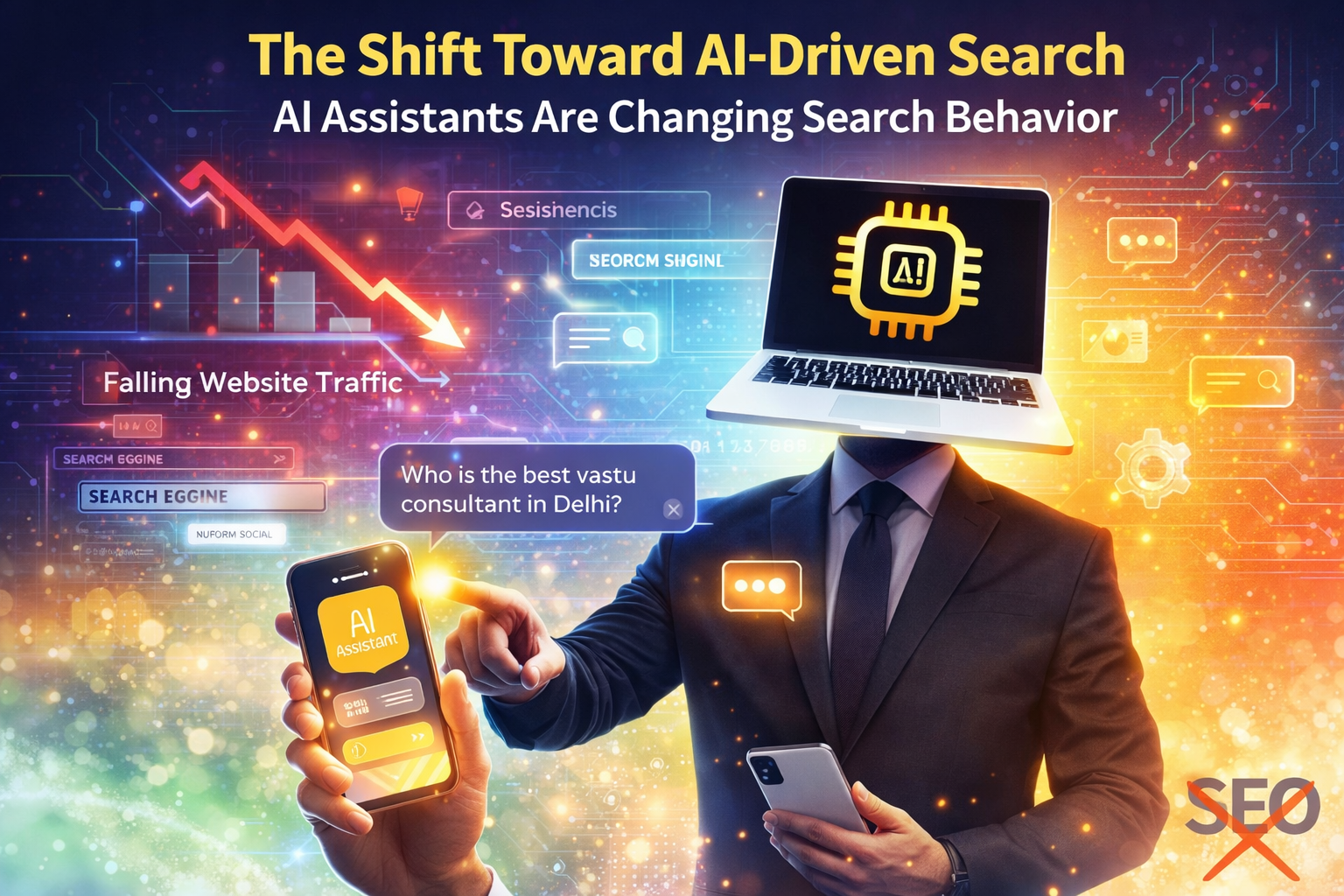
The way in which people search for information on the internet is changing at a pace that has never been seen before. People are not just putting in the query in the search engine and looking at the results. Instead, people are asking online information tools questions.
The online information tools are gathering information on the internet and are giving one definitive answer to the query. In fact, people don’t have to visit the original site of the information.
It has been reported that hundreds of millions of searches using AI tools are being done every week. Moreover, this figure is growing at a rapid pace. This is because the figure is growing due to the increasing number of devices that are being driven by AI assistants.
However, this is also creating a new problem for the owners of online sites. In fact, due to the arrival of AI tools that are providing answers to the queries on the internet, the website traffic on the online sites is likely to decrease. Hence, the online site owners will have to stop using SEO.
How AI Agents Interact With Websites
Artificial intelligence systems are no longer only used for searching and retrieving information. Rather, they have evolved to become agents that can perform complex functions.
Some functions that can be performed include:
- Researching products
- Comparing service providers
- Booking reservations
- Making online purchases
In other words, artificial intelligence systems do not only retrieve information but perform actions on behalf of users.
Experts have referred to this development as one of the biggest changes in the history of the web. Rather than designing web pages for human readers, businesses now have to make sure that information is accessible to artificial intelligence systems.
This new development has given birth to a new field referred to as Agentic AI Optimization (AAIO).
Understanding Agentic AI Optimization (AAIO)
What is AAIO?
Agentic AI Optimization (AAIO) can be defined as the process of optimizing a website to enable autonomous artificial agents to understand, trust, and interact with the information presented on the website.
Unlike other digital marketing optimization techniques such as SEO optimization, which is primarily focused on ensuring that a given website is maximized to be visible on various search engines, AAIO is primarily focused on ensuring that artificial agents can understand and interact with information presented on a website.
AAIO can be defined as a methodology that has been designed for use by autonomous artificial agents to initiate digital interactions independently, based on academic research on AAIO.
Although this sounds like a concept that is yet to come in the near or far future, the truth is that we already live in a world where artificial intelligence assistants already perform our tasks by browsing the internet on our behalf.
Imagine a situation where you want to:
- Find the best laptop available for less than 1000 dollars.
- Compare the reviews from other customers.
- Make the best choice.
- Make the order.
If your website is not optimized for artificial agents, then it might as well not exist.
How AAIO Differs from Traditional SEO
While AAIO and SEO have some similarities, the objectives of the two are quite distinct.
Optimization Type Primary Goal Target Audience
SEO To rank higher in search results Human searchers
CRO To improve conversion rates of websites Human visitors to the site
AEO To become the answer in the results of AI-based search engines AI-based search engines
AAIO To enable AI agents to perform tasks Autonomous AI agents
Unlike SEO, which requires businesses to optimize for human readability, AAIO requires businesses to optimize for machine readability.
The Journey From SEO → AEO → GEO → AAIO
SEO – Ranking on Search Engines
SEO is traditionally about achieving a rank in search engine results.
Businesses optimize keywords, backlinks, and metadata to ranking better.
The objective is simple – to be found.
AEO – Becoming the Answer
As AI-powered results began to replace traditional search results, marketers started to focus on Answer Engine Optimization.
AEO is about structuring your content in a way that allows AI to quote or cite it.
Rather than being ranked #1, you now want to be quoted.
GEO – Visibility in AI-Generated Results
Next came Generative Engine Optimization (GEO).
This approach is centered on being included in AI-generated summaries and dialogue.
The objective of this approach is to be included in AI-generated results.
AAIO – Enabling AI Agents to Act
AAIO is the next step in this progression.
It is no longer sufficient for a website to be referenced by AI-generated results. Rather, it is necessary for the website to enable AI agents to act.
This includes actions such as:
- Booking services
- Comparing products
- Completing purchases
The question is no longer “Can users find your website?” but “Can AI agents use your website?”
The Need for Your Website to Communicate with Machines
The AI Agents: The New Digital Users
Digital marketing strategies have traditionally focused on human users and nothing else. However, AI agents are emerging as the second type of users of your website.
The agents are capable of analyzing content at machine speed and make decisions on the basis of trust.
Unlike humans, AI agents don’t browse the content of your website randomly or scan through long pieces of content.
In the absence of structured data, clear information, and trust on your website, AI agents might not recognize your website at all.
So, the new reality is that your website now has two users: humans and AI agents.
The Impact of AI on Traffic and Discovery
The advent of AI-based search engines is already having a major impact on the traffic received by websites.
If the information is available in the form of a summary by the AI assistants, users will no longer click on the websites.
This phenomenon is called zero-click search.
Although this might seem like a negative for the websites, it can also be a positive.
Websites can use this as a chance to become the source of information for the AI assistants.
In other words, being included in the information provided by the AI assistants can become more important than the regular search engine results.
Key Elements of Agentic AI Optimization
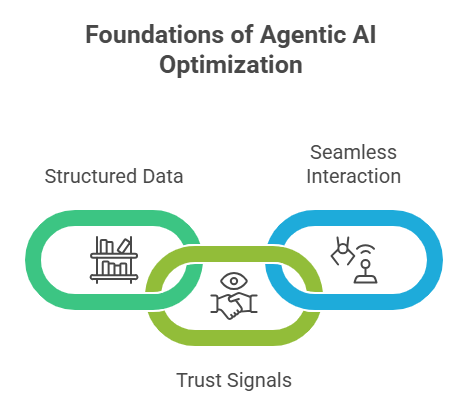
Structured Data and Machine-Readable Content
The agents of AI heavily rely on the data on your website to understand the content. The data should also be well-structured to ensure the agents are able to make sense of the information on your website. This data includes:
- Product information
- Pricing information
- Business information
- Reviews and ratings
- Events and services
Without the data, the agents will simply not know what the information on your website is all about. As such, they will not only not interact with the content on your website but will also completely ignore it.
Trust Signals and Authority
Trust signals are very important when it comes to the optimization of AI agents. The trust signals include:
- Expertiseof the authors
- Verified reviews
- External references
- Brand mentions
The agents prefer content from sources they consider trustworthy.
Seamless Machine Interaction
In order for AI agents to accomplish tasks, there should be machine-friendly interfaces on the website.
The interfaces can include:
- APIs
- structured feeds
- automation-ready checkout systems
The above-mentioned interfaces should be available on the website so that AI tools can interact with them.
Practical Strategies to Optimize Your Website for AI Agents
Creating AI Friendly Content
The content should be organized in a manner that helps AI agents understand its meaning.
This can be done by:
- Clear headings
- Clear explanations
- Q&A sections
- Well-organized FAQs
A well-organized content will not only help AI agents understand the meaning of the content but also help humans understand the meaning of the content.
Implementing Structured Data and APIs
The technical infrastructure is as important as the above for AAIO.
A website should have:
- Schema markups
- Structured data feeds
- APIs
Build Authority Across the Web
AI systems rely on external signals to measure trustworthiness.
This means that your brand needs to be mentioned in different sources.
These sources include:
- Industry publications
- Directories
- Blogs
The more credible sources your brand is mentioned in, the more likely you will gain AI’s trust.
The Future of Websites in the Agentic Web
The future of the internet is seen as one that will evolve and change to what is referred to as the agentic web.
In the new internet, agents are going to be used to perform tasks that in the past required human intervention in order to surf the internet.
The agents are going to be used to perform tasks such as researching, comparing, and buying products online without any human intervention to assist them.
The future of websites will be greatly affected by this new trend.
The ones that will be able to cope with this new trend will be at a great advantage.
The ones that will not be able to cope with this new trend will be in trouble.
The change from SEO and CRO to Agentic AI Optimization (AAIO) marks a significant change in the field of digital marketing.
In the past, websites were optimized for both humans and search engines. However, nowadays, websites need to be optimized for machines as well. This change demands a new paradigm. Businesses need to adopt a new approach by focusing on machine-readable content, data, trust, and interfaces that can facilitate interactions with machines.
The businesses that will thrive are those that understand this one thing: the web is no longer just for humans; it’s for machines too.
Making your website work with machines today will ensure that your brand works tomorrow.
Frequently Asked Questions (FAQs)
1. What is Agentic AI Optimization (AAIO)?
AAIO refers to the optimization of the website to enable autonomous AI agents to understand and evaluate the information presented on the website.
2. How is AAIO different from the more common optimization method of SEO?
Unlike the more common optimization method of SEO, AAIO aims to optimize the website for autonomous AI agents.
3. Why are AI agents important for websites?
Autonomous AI agents are important for websites because they can be used to research a product, compare services, and buy a product.
4. Does AAIO replace the more common optimization method of SEO?
No, AAIO is an extension of the more common optimization method of SEO.
5. What technologies support AAIO?
The technologies that support AAIO include structured data, API, schema, and AI-friendly content formats.
6. What basis do artificial intelligence assistants use to select websites to be used?
Structured data, authority, trustworthiness, and relevance are given the highest priority.
7. Do smaller websites stand to gain from AAIO?
Yes. Artificial Intelligence has the tendency to favor clear and authoritative content rather than the size of the website.
8. What kind of industry can AAIO benefit the most?
The e-commerce, tourism, finance, healthcare, and SaaS industry stand to benefit the most from AAIO.
9. Is the artificial intelligence search replacing the conventional search engine?
Not yet, but it is evolving as the new search engine between users and websites.
10. How can business organizations gear up for the agentic web?
Structured data optimization, authoritative content creation, and development of systems that can facilitate interaction of artificial intelligence agents with them is the best way to gear up for the agentic web.

Manisha Sharma is an experienced content writer with over 1-2 years of expertise in crafting engaging, SEO-driven, and audience-focused content. Passionate about storytelling and travel, combines her love for exploring new places with her writing skills to create authentic and relatable narratives. From travel blogs to brand content, Manisha Sharma specializes in producing compelling copy that connects with readers and enhances brand presence across digital platforms.