Boost Mobile Ad Engagement with Visual Sitelinks Extensions
Understanding Visual Sitelinks Extensions
Visual Sitelinks Extensions are a new form of advertising in Google Ads, which has provided advertisers with a new way of making sitelink extensions more engaging for users. Unlike traditional sitelink extensions, which are used in Google Ads for connecting users with relevant pages on a website, visual sitelink extensions are more interactive in nature. This is because they show images in addition to sitelinks. This is a new way of advertising in Google Ads, which is mainly used for mobile search ads because images attract the user’s attention more than text.
Traditional sitelink extensions are used in Google Ads for connecting users with relevant pages on a website. Visual sitelink extensions have taken this concept to a whole new level because they have provided advertisers with a way of engaging users by allowing them to swipe images and click on the image they think is the most relevant. For example, if you are an owner of an online clothing store, you can add sitelinks like “Men’s Jackets,” “Women’s Dresses,” “Summer Sale,” etc.
These extensions function like a digital storefront appearing directly in the search results. If an individual is searching to find a product or service, they will be able to view visual choices related to various sections of a website. This enables businesses to feature several products within a single advertisement while increasing the probability that an individual will click the link to the relevant advertisement based on their intent to search.
Visual sitelinks are activated by keyword searches and allow users to access specific sections of an advertiser’s website.
How Visual Sitelinks Extensions in Google Ads Work
Visual sitelinks extensions function in a similar manner to other Google Ads extensions. However, the visual sitelinks extensions have been optimized to function on mobile devices. When a user enters a keyword in the Google search engine, the ad will appear on the search results page. If the ad has been optimized to include visual sitelinks extensions and meets the requirements by Google, the extensions will appear on the search results page in a horizontal format. These extensions will comprise a number of click-through cards. These cards will have a picture and a headline, and the user will be able to swipe to the image they are most interested in.
Ad ranking is an important factor. Sitelinks appear when an ad is shown in a top position. This gives the sitelinks maximum visibility. These sitelinks are intended to be used by mobile devices. This is important since this is the current trend in searching, where everyone is searching with their gadgets.
In regular Google Ads sitelinks, businesses can add links to different levels, including account, campaign, and ad group. These links can be to products, services, store hours, and other relevant pages. This is an extension of the idea, but with the addition of images to make the process easier and engaging.
Why Visual Sitelinks Matter in Modern Mobile Advertising
The Rise of Mobile-First Advertising
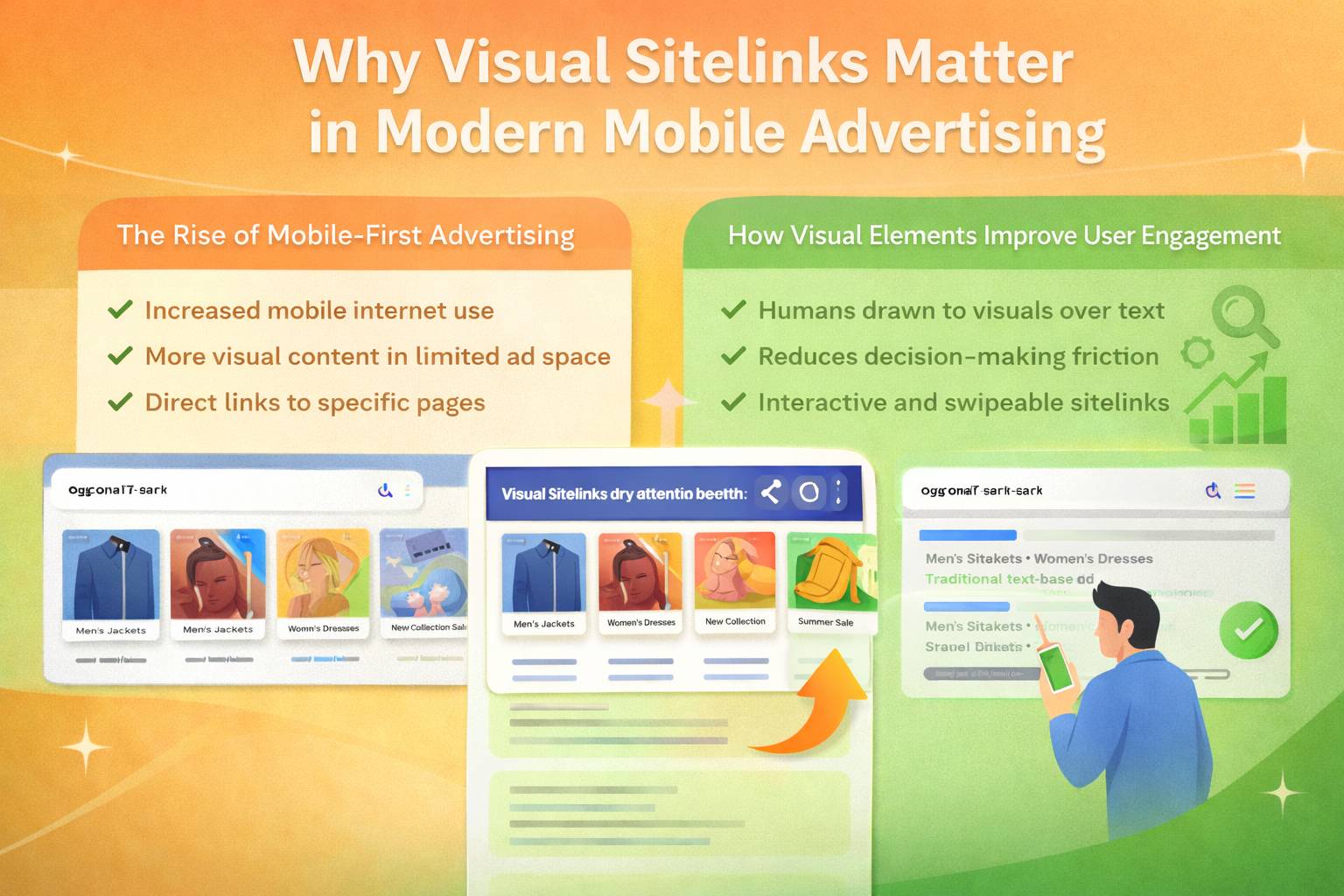
In the past ten years, the digital marketing industry has undergone a significant revolution with the advent of the ‘mobile-first’ era. Currently, a significant percentage of the online population is using their devices to search the internet. The online population is looking for immediate information or content that is visually appealing. They need to be able to navigate through the content. Text-based advertisements cannot effectively catch the attention of the online population. The online population is not looking at reading the headlines to know the products or services offered by the companies. They can have a sneak peek at the products or services offered by the companies with the introduction of visual ‘sitelinks.’ The online population is looking at shopping in the present day in the way mentioned above.
Another reason why visual sitelinks are important is the small screen size. Due to the small size of the mobile device screens, advertisers face competition for the limited space. With the use of visual sitelinks, businesses can occupy more visual space on the search engine results page. This can help push the ads of the competitors further down the page.
Another advantage of the mobile-first approach is the efficiency in navigating the website. One can navigate to the page they want directly without going to the homepage. For example, if the user wants to purchase “running shoes,” they can click the sitelink “Men’s Running Shoes” instead of going through the various pages.
How Visual Elements Improve User Engagement
Human psychology is such that it is easier to catch the attention of users with visuals. Digital marketing research has proven time and again that users can be attracted with the help of images more efficiently compared to the use of texts. While users go through the search engine results, the colorful visuals can catch their attention at once.
The visual sitelinks feature is based on the psychological aspect of users. The image will be like an advertisement in itself representing the type of product or service being offered. The users will not be required to think about the appearance of the product or service.
This mode of visual communication would also be useful in the reduction of friction in the process of decision-making. They would be able to determine if the product or service has a connection with them. If they get a feeling of connection with the image they see, they would be willing to click on the link.
The user would be more engaged because they would be able to interact with the ad by swiping the visual sitelink. They would get a feeling of exploration. Instead of looking at the ad, they would be able to explore different things. They would get the feeling of being helped and not being presented with an ad.
Key Features of Visual Sitelinks Extensions
Swipeable Image Carousel
One of the most outstanding features of the visual sitelinks extensions is the swipeable image carousel. This feature enables the display of several images at the bottom of the main advertisement. The images can then be swiped from left to right to display all the images. This feature has been quite common in most mobile devices such as social media and e-commerce apps. As such, this feature has proven to be quite intuitive as users are already accustomed to the feature. The feature has proven to be quite useful as the advertisement becomes a product gallery where images represent the categories of the product.
Multiple Landing Page Links
Another outstanding feature of the visual sitelinks extensions is the feature that enables the display of multiple links in the advertisement. Unlike the older extensions where users were redirected to the main page of the website, the new feature enables users to be redirected to various parts of the website.
For example, for an online store selling electronic items online, the sitelinks can be as follows:
- Smartphones
- Laptops
- Smart Watches
- Accessories
This is good as it improves user experience as the user can go directly to the page instead of searching for it on the site.
Mobile-Focused Design
The visual sitelinks have a design that is specifically tailored for a mobile environment. They have an image size and layout that is suitable for a small screen. This is because the user has a short time to make a decision and thus needs information in a presentable and engaging manner.
Traditional sitelinks have the option of displaying several links at the bottom of ads on both desktop and mobile devices. They can display up to eight links on a mobile device in a carousel format. Visual sitelinks have expanded on this idea by including images, which greatly improve the user experience.
Types of Visual Sitelinks Extensions
Product-Based Visual Sitelinks
Sitelinks are normally used by e-commerce businesses. The visual sitelinks extensions will be very helpful to businesses in displaying images of various products or categories of products. For example, the business may be in the fashion industry. The business may use images representing various products such as shoes, handbags, jackets, and accessories.
Each image may represent various products for the user to click on. For example, if the user clicks on the image representing the product “shoes,” they may be redirected to the page where images represent various products such as “Nike,” “Adidas,” “Puma,” and “Converse.”
Service-Based Visual Sitelinks
Service-based businesses may benefit from the use of the visual sitelinks extensions. The images may represent images representing various services offered by the business. For example, the business may be in the digital marketing industry. The business may use images representing the services offered by the business.
The images may help the user understand the services offered by the business. For example, the image representing the services “SEO” may help the user understand the concept of “SEO services” better than the text.
Promotional Visual Sitelinks
Promotional visual sitelinks focus on the benefits associated with the promotion, the promotion itself, the promotion as a discount, the promotion as an offer, or the promotion as being specific to the season. The promotional visual sitelinks are active in the retailer’s ad campaign for the big shopping event such as the holiday sale or the launch of new products.
For example, if the retailer has created an ad campaign for the big shopping event “Summer Sale,” the retailer may use the following promotional visual sitelinks: “50% Off Shoes,” “New Summer Collection,” and “Limited Time Offers.” Promotional visual sitelinks have the power to attract more consumers.
Benefits of Using Visual Sitelinks Extensions
Higher Click-Through Rates
The first significant advantage of visual sitelinks extensions is that they can increase click-through rates (CTR). This is so since ads containing visual elements are more eye-catching compared to those containing only text.
For instance, if a user is searching for information on “the best backpacks for travels,” they will definitely click on a sitelink containing a picture of a stylish backpack instead of a text link.
Increased Ad Visibility
The next major advantage is increased ad visibility. Ad visual sitelinks are more prominent on the screen, hence more likely to stand out from the competition. The increased real estate does not only promote more click-throughs but also increases the chances of creating brand recognition.
If consumers are consistently exposed to an ad from a particular brand, they will eventually become familiar with it, more so in a competitive environment.
Guidelines on How to Create Effective Visual Sitelinks Extensions
Selection of the Right Image
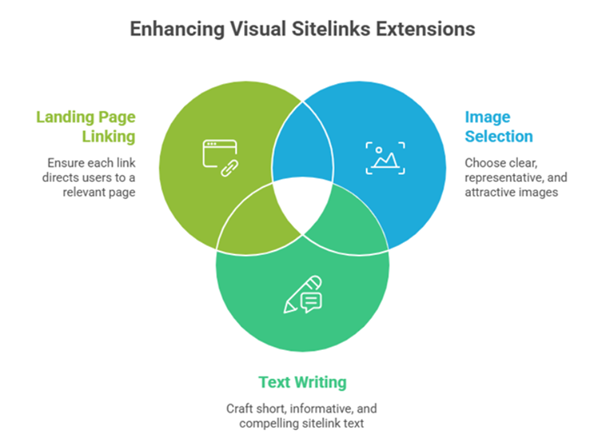
The importance of the image in the success of the visual sitelinks extension cannot be overstated. For the visual sitelinks extension to be effective, the image used has to be clear and representative of the service or product being offered. A poor image will definitely have a negative impact on the user and may even dissuade the user from clicking the sitelinks extension.
The best images to use in the sitelinks extension are those which are simple, clear, and attractive.
Writing Compelling Sitelink Text
The text used for images is also important, though these images are visually appealing. The text used for sitelinks has to be short and have to carry information on what users will find when clicking on the sitelink.
For example, instead of writing “Explore More,” you can write “Shop Summer Shoes” or “Book Free Consultation.”
Linking to Relevant Landing Pages
Each image used for sitelinks has to be linked to a highly relevant page on your website. This is important because if you have images for sitelinks on your website, and users click on those images hoping to find what they need, but are instead taken to your homepage, they will definitely leave your website.
Each text used for sitelinks has to be relevant to the pages users will be taken to for a better user experience. This will greatly improve your conversion rate as users will find exactly what they were looking for from your advertisement.
Best Practices for Optimizing Visual Sitelinks Extensions
Advertisers can make the most out of their visual sitelinks by optimizing them. Advertisers can do so by undertaking various best practices. Advertisers can, for instance, carry out tests to determine what works better for their visual sitelinks. Advertisers can as well keep checking their campaign analytics from time to time to determine whether there are sitelinks that are not performing as expected and therefore need optimization.
The second best practice is to ensure consistency. The images used in sitelinks are supposed to be consistent with those used on the website of the brand. This will help in creating trust between consumers and brands.
The last best practice is to make sure that your visual sitelinks are relevant. The sitelinks are supposed to be relevant to the search intention of the user. This is because when the information on the sitelink is relevant to the search query of the user, it is likely to engage with the ad.
Conclusion
The Visual Sitelinks Extensions have brought about a significant advancement in advertising within the world of search advertising. This has enabled advertisers to add images and links to their advertisements, thus transforming text-based advertisements into visually stimulating advertisements.
The Visual Sitelinks Extensions have been developed for the increasing number of mobile device users. This has enabled advertisers to advertise several products and services within the search engine results.
The world is becoming more and more digital, and people’s attention spans are shrinking. This has led to increased competition for clicks within the world of digital advertising. Visual sitelinks have provided advertisers with a significant advantage in this digital world.
The increasing number of mobile device users is set to play a significant role in the world of digital advertising. This has enabled several businesses to utilize the Visual Sitelinks Extensions for advertising purposes, thus gaining a significant advantage in the world of digital advertising.
Take Your Advertising to the Next Level with Nuform Social.
Optimize Your Google Ads Campaigns Today with Visual Sitelinks Extensions and Take Your Business to the Next Level.
Contact Nuform Social Today and Take Your Search Ads to the Next Level.
FAQs
1. What are Visual Sitelinks Extensions in Google Ads?
2. Are Visual Sitelinks available for desktop devices?
3. Do Visual Sitelinks improve Google Ad performance?
4. How many visual sitelinks can be included in Google Ad?
5. What type of business can benefit from Visual Sitelinks?

Manisha Sharma is an experienced content writer with over 1-2 years of expertise in crafting engaging, SEO-driven, and audience-focused content. Passionate about storytelling and travel, combines her love for exploring new places with her writing skills to create authentic and relatable narratives. From travel blogs to brand content, Manisha Sharma specializes in producing compelling copy that connects with readers and enhances brand presence across digital platforms.