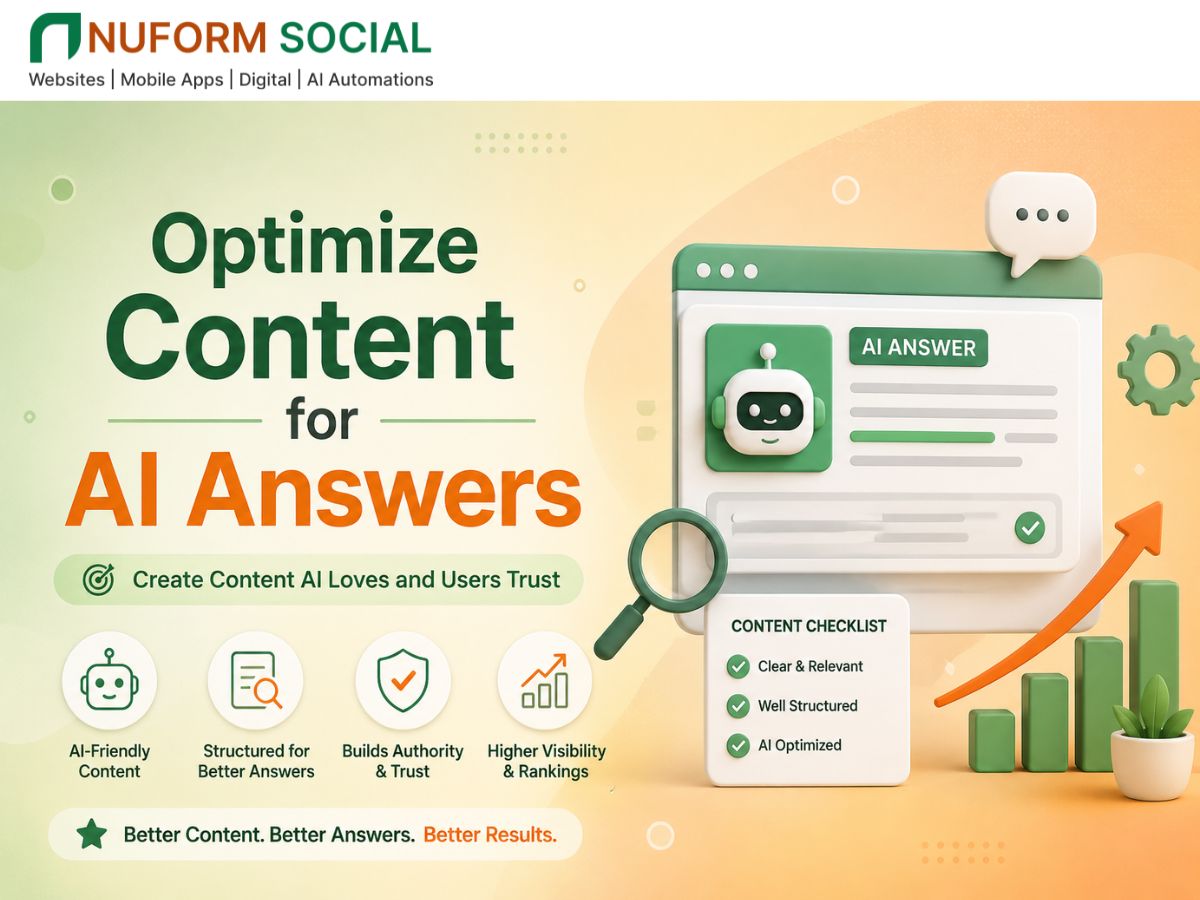
The way people search for information is changing rapidly. Instead of clicking through multiple websites, users now receive direct answers from AI-powered platforms such as ChatGPT, Google AI Overviews, Gemini, and Perplexity. This shift has created a new opportunity for website owners, marketers, and businesses. If you can optimize content for AI answers, your brand can appear directly within AI-generated responses, increasing visibility and authority without relying solely on traditional search rankings.
Recent industry research shows that AI-generated search experiences are growing rapidly, with a significant percentage of informational searches now displaying AI-generated summaries and answer boxes. As AI search adoption continues to rise, businesses that adapt early will have a substantial competitive advantage.
In this guide, you’ll learn exactly how to optimize content for AI answers, improve your chances of being cited by AI systems, and future-proof your content strategy for the evolving search landscape.
What Does It Mean to Optimize Content for AI Answers?
To optimize content for AI answers means structuring and presenting information in a way that AI systems can easily understand, extract, and reference when generating responses. Unlike traditional SEO, where the goal is to rank high in search results, AI optimization focuses on becoming the source that AI tools trust and cite.
Think of AI search as a highly intelligent librarian. Instead of handing users a list of books, it reads the books and delivers a summarized answer. Your goal is to make your content so clear, accurate, and trustworthy that the librarian chooses your information.
The Rise of AI-Powered Search
AI search platforms are changing how users interact with information. Many users now prefer conversational queries and direct answers rather than scrolling through dozens of search results. This shift is driving the growth of Answer Engine Optimization (AEO) and Generative Engine Optimization (GEO), both of which focus on increasing visibility within AI-generated responses.
Why Traditional SEO Is No Longer Enough
Traditional SEO remains important, but rankings alone no longer guarantee visibility. AI systems often pull information from multiple sources, combine insights, and present a synthesized answer. This means your content must be optimized not only for search engines but also for AI retrieval and citation systems.
How AI Search Engines Choose Content
Understanding how AI systems select content is the foundation of successful AI optimization.
Understanding AI Citations
AI platforms typically retrieve content from trusted web sources, evaluate relevance, and generate responses based on the information available. The content most likely to be cited often contains:
- Clear answers
- Strong topical relevance
- Reliable sources
- Structured formatting
- Up-to-date information
Research indicates that topical relevance remains one of the strongest factors influencing whether content gets cited in AI-generated responses.
Key Ranking Signals for AI Answers
Signal | Importance |
Direct answers | Very High |
Content structure | High |
Topical authority | High |
Fresh information | High |
Schema markup | Medium-High |
Trust signals | High |
User experience | Medium |
AI systems prioritize content that is easy to understand and highly relevant to the user’s question.
Why Businesses Must Optimize Content for AI Answers
Businesses that optimize content for AI answers gain significant advantages over competitors who rely solely on traditional SEO strategies for zero clicks.
Increased Visibility
When AI tools cite your content, your brand gains exposure even when users never visit search result pages. This visibility can improve brand awareness and trust among potential customers.
Better Brand Authority
Being referenced by AI-generated answers positions your website as a trusted source. When users repeatedly encounter your brand within AI responses, credibility naturally increases.
Industry studies suggest that pages cited in AI answers often experience stronger brand recall compared to standard search listings.
10 Proven Ways to Optimize Content for AI Answers
1. Use Question-Based Headings
AI systems often match content to user queries. Headings that mirror real questions improve the chances of content being selected.
Examples include:
- What is Answer Engine Optimization?
- How Does AI Search Work?
- Why Is AI SEO Important?
Question-based headings create clear contextual signals that help AI systems identify relevant sections.
2. Provide Direct Answers First
One of the most effective ways to optimize content for AI
answers is to place concise answers immediately after headings.
For example:
What is AI SEO?
AI SEO is the process of optimizing content so AI-powered
search engines can easily understand, retrieve, and cite it when generating
responses.
After providing the direct answer, expand with detailed
explanations and supporting information.
3. Create Comprehensive Content
AI systems prefer content that thoroughly covers a topic rather than superficial articles. Comprehensive content demonstrates expertise and provides AI with more context.
Cover related questions, supporting concepts, examples, statistics, and practical applications within a single article whenever possible.
4. Build Topical Authority
Topical authority is becoming increasingly important. Rather than publishing isolated articles, create clusters of related content around a specific subject.
For example:
- AI SEO
- AI Search Ranking
- Answer Engine Optimization
- Generative Engine Optimization
- AI Content Strategy
Together, these articles signal expertise to both search engines and AI systems.
5. Use Structured Data
Structured data helps machines understand content more effectively.
Useful schema types include:
- FAQ Schema
- Article Schema
- How-To Schema
- Organization Schema
Many AI optimization experts consider schema markup a critical factor in improving AI visibility.
6. Improve Content Readability
AI systems favor content that is easy to interpret.
Best practices include:
- Short paragraphs
- Clear headings
- Simple language
- Logical organization
- Bullet points where appropriate
Readable content benefits both users and AI systems.
7. Add Statistics and Credible Sources
Trust plays a major role in AI citation decisions.
Adding current statistics, research findings, and expert insights increases content credibility. AI systems often prefer content supported by verifiable information rather than unsupported claims.
8. Optimize for Voice Search
Many AI-powered searches resemble natural conversations.
Instead of targeting only short keywords, include conversational phrases such as:
- How can I optimize content for AI answers?
- What is the best AI SEO strategy?
- Why is answer engine optimization important?
Voice-friendly content aligns closely with modern AI search behavior.
9. Maintain Content Freshness
AI systems increasingly value current information.
Regularly update:
- Statistics
- Industry trends
- Examples
- Screenshots
- Best practices
Fresh content signals relevance and improves the likelihood of citation. Recent timestamps have been shown to positively influence AI citation likelihood.
10. Strengthen E-E-A-T Signals
Google’s E-E-A-T principles remain highly relevant:
- Experience
- Expertise
- Authoritativeness
- Trustworthiness
Include:
- Author bios
- Credentials
- Case studies
- Original research
- Customer reviews
Trust signals can significantly improve visibility in AI-generated answers.
Common Mistakes to Avoid
Keyword Stuffing
Many website owners make the mistake of repeating keywords excessively. While it may seem logical, AI systems prioritize quality, clarity, and relevance over repetition.
Maintain a natural keyword density of approximately 1–2% for optimize content for AI answers while ensuring readability remains high.
Thin Content
Short, shallow articles rarely perform well in AI search environments. Content should fully answer user questions and provide meaningful value.
If your article leaves important questions unanswered, AI systems may choose a more comprehensive source.
Future of AI Search Optimization
The future of search is increasingly centered around direct answers rather than traditional result pages. As AI systems continue evolving, optimization strategies will focus more on answer quality, entity recognition, authority signals, and user trust.
Researchers studying AI-generated search environments have found that structured information and trustworthy content play increasingly important roles in AI visibility.
Businesses that begin optimizing today will be better positioned as AI search adoption expands.
Start Optimizing for AI Answers Today
Every day, more users rely on AI-powered search tools to find information. If your content isn’t optimized for these platforms, you’re missing valuable opportunities to increase visibility, build authority, and attract qualified traffic.
Start by auditing your existing content, improving structure, adding direct answers, implementing schema markup, and building topical authority. The sooner you optimize content for AI answers, the faster you’ll gain a competitive advantage in the new era of search.
Conclusion
The search landscape is undergoing a major transformation. Ranking on search engines is still valuable, but visibility within AI-generated answers is becoming equally important. Businesses and content creators who optimize content for AI answers can position themselves as trusted sources across AI platforms, voice assistants, and search engines.
Success comes from combining traditional SEO with AI-focused optimization strategies. Clear answers, strong authority, structured content, fresh information, and trust signals all contribute to better AI visibility. The brands that embrace these changes today will be the ones leading tomorrow’s search results.
FAQs
1. What does it mean to optimize content for AI answers?
2. Is AI optimization different from SEO?
3. How important are FAQs for AI visibility?
4. Does schema markup help AI search rankings?
5. How often should I update content for AI search?

Manisha Sharma is an experienced content writer with over 1-2 years of expertise in crafting engaging, SEO-driven, and audience-focused content. Passionate about storytelling and travel, combines her love for exploring new places with her writing skills to create authentic and relatable narratives. From travel blogs to brand content, Manisha Sharma specializes in producing compelling copy that connects with readers and enhances brand presence across digital platforms.